

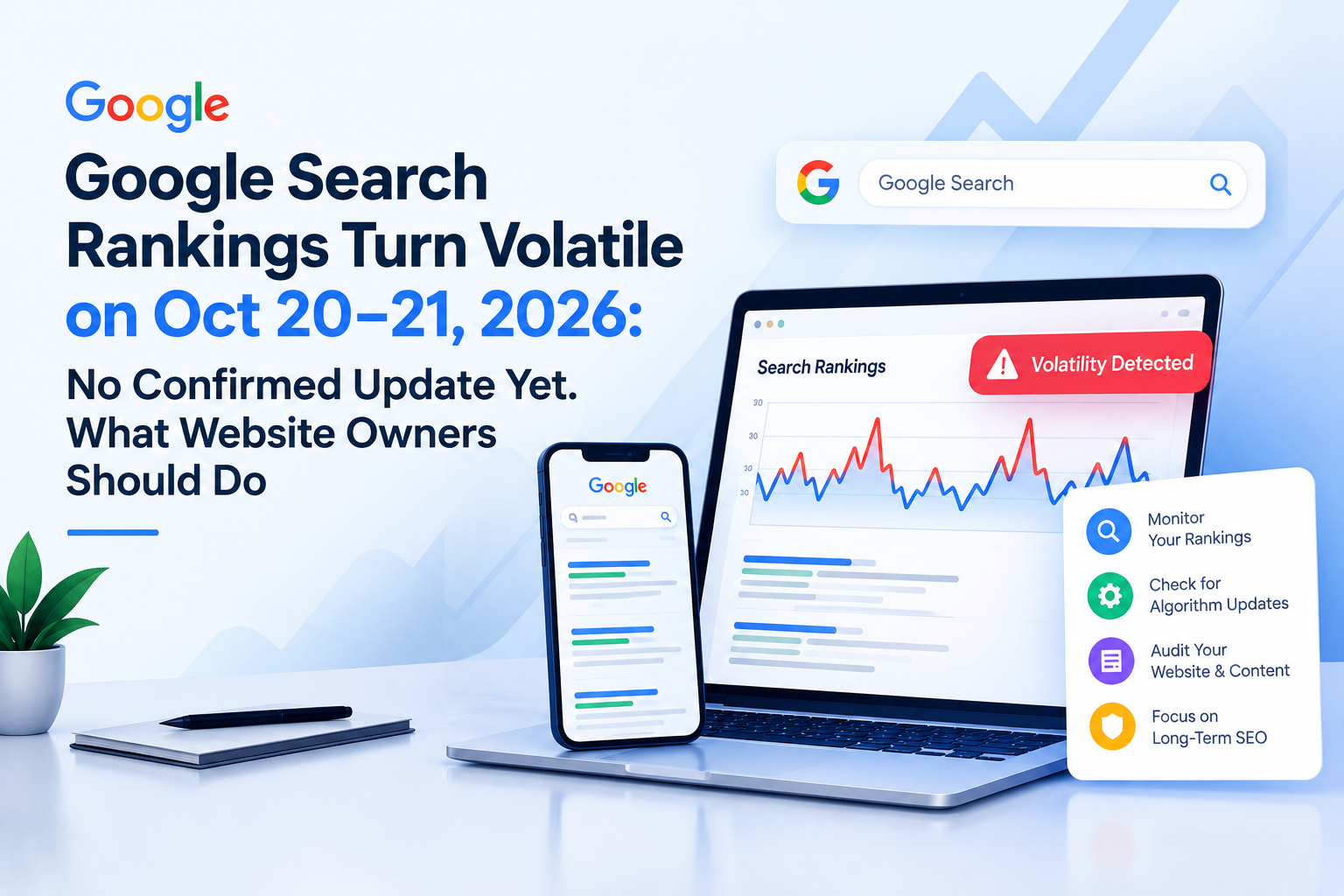
Quick answer: Google Search rankings appeared highly volatile on October 20 and 21, 2026, and industry chatter spiked to unusual levels. However, Google has not confirmed any new ranking update. The most recent confirmed change on Google's Search Status Dashboard is the September 2026 spam update, which began on September 24 and finished on October 8. If your traffic moved this week, do not panic or rewrite your site. Check your data, wait for confirmation, and fix real quality issues.
What Happened to Google Rankings on October 20–21, 2026?
According to the Search Engine Roundtable daily recap for October 21, search results looked very volatile again, and discussion among SEOs and site owners rose sharply over the previous 24 hours. Volatility tracking tools and webmaster forums reflected the same pattern.
Importantly, volatility is not the same as a confirmed update. Google only lists updates it chooses to announce, and rankings shift constantly for many reasons, including testing, new content, and changes to search features.
Has Google Confirmed an October 2026 Update?
No. As of October 19, 2026, the latest ranking entry on the Google Search Status Dashboard, as reported by Search Engine Watch, was the September 2026 spam update. Site owners have reported falling Google Discover traffic, stale results in Google News, and delays in Search Console data. Google had not confirmed a related update at the time of that report.
| Item | Status | Detail |
|---|---|---|
| September 2026 spam update | Confirmed, complete | Started September 24 and finished October 8, taking longer than the earlier spam updates this year |
| October 2026 core update | Not confirmed | No entry on Google's dashboard as of the latest reports |
| Last confirmed core update | May 2026 | Per industry tracking of Google's ranking history |
| Oct 20–21 ranking volatility | Reported by SEO community | Unconfirmed by Google |
Other Google Search News This Week
- Documentation update (October 21): Google updated its "control what you share with Google Search" guidance. It now lists existing options such as the robots meta tag,
data-nosnippet,X-Robots-Tagand the Search generative AI control, according to Google Search Central's documentation updates. - Multimodal reporting in Search Console: Google launched reporting on searches that use Lens, Circle to Search on Android, image uploads and the Chrome "Search this image" feature, as covered in October's AI SEO news roundup.
- Discover test: Google is testing a "Dive deeper" feature in Discover that uses AI to summarise a topic and link to related stories.
- Search page tests: Google is testing removal of the thin divider line under the search tabs, and Bing is reportedly testing hiding sitelinks under some results.
- Rank tracker accuracy: One tracking vendor reported that a share of results pages Google served to automated requests were incorrect since late September, which may distort rank-tracking data. Treat this as a vendor claim and cross-check with Search Console.
Why Rankings Move Even Without a Named Update
- Unannounced tweaks: Google makes many small changes every day.
- Delayed effects: The effects of a large update can keep shifting after it is marked complete.
- Search feature changes: AI Overviews, Discover and News tests change who gets clicks without changing classic rankings.
- Tool noise: Rank trackers can show false drops, especially if the data they collect is inaccurate.
- Competitor activity: Rivals publishing or improving pages can push you down.
What Website Owners Should Do Now
- Check Google Search Console first. Compare clicks, impressions, average position and top pages for the last 7 days against the previous 7 days. Use Search Console, not just third-party trackers.
- Separate Search, Discover and News. A fall in Discover or News traffic is not the same as a ranking loss in web search.
- Do not make panic changes. Mass rewriting, deleting pages or changing URLs during volatility usually makes diagnosis harder.
- Wait for confirmation. Check the Google Search Status Dashboard before blaming an update.
- Audit the basics. Confirm your pages are indexable, load quickly, work on mobile, and are not hit by manual actions or security issues.
- Review content quality. After a spam update, remove or fix thin, duplicated or manipulative pages, including low-value pages and spammy links.
- Check your snippet and AI controls. Make sure
robotsanddata-nosnippetsettings match what you actually want Google to show. - Track results for 2 to 4 weeks before judging the impact of any change.
How a Well-Built Website Protects You From Ranking Swings
No site is immune to volatility, but technically sound, fast, mobile-friendly websites with clear content and proper SEO foundations recover more predictably. Domisec builds on-page SEO, metadata, sitemaps, speed optimisation and analytics into its website development packages. Not sure what a proper rebuild would cost? Read our website design cost guide for India or talk to the Domisec team. No agency can guarantee rankings, and we will never promise them.
What to Watch Next
Watch the Google Search Status Dashboard and the Search Central blog for any confirmation. Forecasting models and forum chatter suggest more movement could come, but these are predictions, not announcements. We will update this article if Google confirms an update.
Sources: Search Engine Roundtable, Search Engine Watch, Google Search Central documentation updates, and Position Digital's AI SEO news roundup, as of October 22, 2026. Information may change as Google confirms details.

Comments & Discussion
Leave a Comment
Share your questions, ideas, or architectural feedback. Your comment will appear immediately.
No comments yet
Be the first to share your thoughts or start a discussion on this topic.