
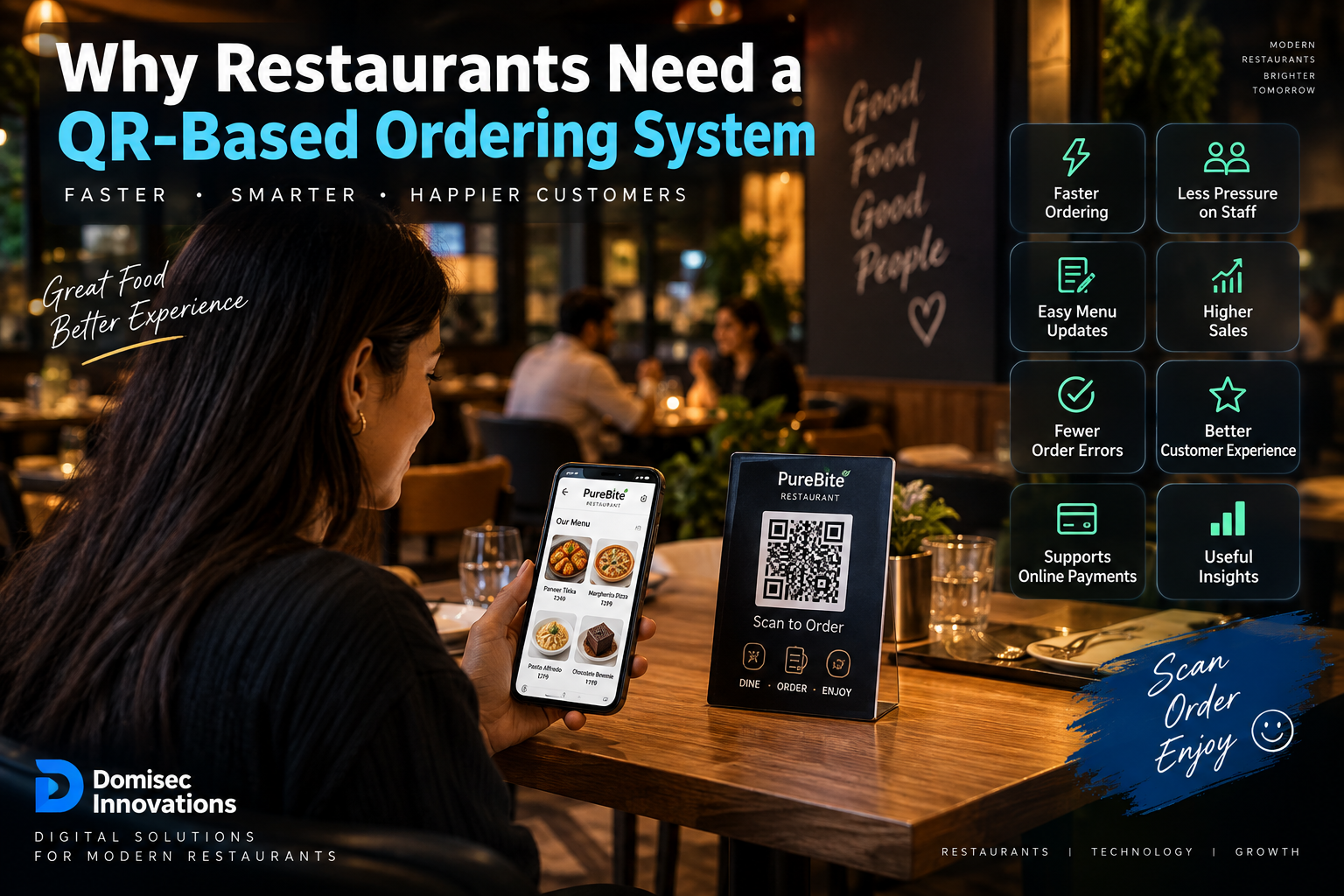
Why Restaurants Need a QR-Based Ordering System
The restaurant industry is shifting towards digitization. Customers demand efficiency and convenience at every step of the ordering process.
One such technology that is helping the restaurant industry digitize its processes is a QR-based ordering system.
With a QR code ordering menu, customers no longer have to wait for a waiter to come to their table, bring the menu, take the order and return with the food.
But is a QR ordering system really necessary for a restaurant?
In many cases, yes! For modern eateries, cafes, food courts, and cloud kitchens, it can be an excellent addition to speed up the ordering process and deliver a better customer experience.
What Is a QR-Based Restaurant Ordering System?
A QR-based restaurant ordering system enables the establishment to place QR codes anywhere in the venue or on food packages.
When a customer scans the code, it gives the customer access to a digital restaurant menu and enables them to browse, personalize, and order from a restaurant menu directly from their table.
Depending on the solution, a QR code can enable customers to:
• Browse an entire menu
• See food images
• Read descriptions
• Check prices
• Specify food variations
• Customize the order
• Add items to their cart
• Place the order
• Call for waiter
• Make payments
• Track the order status
From this, you can see that there is a digital bridge between the customer, waiter, kitchen, and the QR code ordering system.
1. Speeds Up Ordering
One of the most apparent benefits of a QR code ordering menu is the ability to order faster.
A typical ordering process consists of the following steps:
1. Waiting for a waiter.
2. Asking for a menu.
3. Making the choice.
4. Waiting for a waiter.
5. Giving the order.
6. Waiting for the order to be entered into the restaurant POS.
With a QR-based system, several of the steps can be taken away (depending on the capabilities of the system) and the ordering process is significantly shortened.
It will especially be helpful during peak hours when restaurants are overwhelmed with customers and the staff is constantly trying to keep up with the demand.
2. Eases Restaurant Staff
Similar to the previous point, a QR code ordering menu can take some of the repetitive, stressful tasks off the waitstaff.
During rush hours, restaurant staff has to multi-task.
They may have to:
• Greet customers.
• Give menus.
• Take orders.
• Answer the menu-related questions.
• Enter orders into the system.
• Manage the kitchen.
• Take payments.
With a QR-based system, some of this pressure can be redirected elsewhere.
The customer would take care of the menu browsing and order submitting tasks and the staff can focus on providing excellent customer service.
3. Easier Updates
Updating a menu is not an easy task.
A physical menu requires the restaurant to print hundreds of new menus every time there is a price change, new dish addition, or seasonal specialties launch.
With a digital QR code menu, the restaurant no longer has to update hundreds of documents. All changes can be made on the restaurant dashboard.
Take this example:
Old price: ₹199
New price: ₹229
Previously, the restaurant would have to update the price in every single printed menu. With a digital menu, it would only have to update it once on the POS dashboard.
4. Better Menu Presentation
A digital QR code menu enables a restaurant to present its menu more attractively.
With a physical printed menu, the presentation is limited to a few text descriptions and possibly a picture or two.
With a digital menu, the possibilities are endless. All the following can be added to the QR-based restaurant menu:
• Food images;
• Descriptions;
• Ingredients;
• Spice level;
• Vegetarian/non-vegetarian;
• Allergens;
• Add-ons;
• Customization options;
• Recommended dishes.
Instead of seeing the following on a menu:
«Paneer Tikka — ₹249»
...The customer will see the following:
A picture of Paneer Tikka with a description, available add-ons, and customization options.
5. More Upselling Opportunities
A QR-based ordering system enables a restaurant to upsell during the ordering process.
For example, if a customer wishes to add a burger to their order, the customer will be able to see the following on the ordering page:
Complete Your Order
• Add Fries +₹59
• Add Cold Drink +₹49
• Add Extra Cheese +₹30
Or suggest the following:
• Combo Meals;
• Desserts;
• Beverages;
• Premium add-ons;
• Special dishes;
This would enable the restaurant to make additional sales without putting extra pressure on the staff.
6. Less Human Errors
A downside of the classic table-ordering process is the possibility of errors.
For example, if a customer says the following to the waiter:
«"One cheese burger, no onions, extra cheese."»
...The customer is likely to get a wrong dish if the waiter inputs the order incorrectly into the restaurant POS.
With a digital QR ordering system, the restaurant will know exactly what the customer ordered and there is less chance of miscommunication.
The ordering system will send the exact order (with customization notes) directly to the restaurant dashboard or kitchen, depending on the system.
7. More Customer Control
Not every customer wants to interact with a waiter just to get another glass of water.
After finishing their meal, some customers wish to:
• Order another drink;
• Order dessert;
• Get extra sauce;
• Get a glass of water;
• Order more food.
With a QR code menu, all of the above can be done seamlessly by simply rescanning (or reopening) the QR link, depending on the system.
8. Great for Rush Hours
One of the most stressful scenarios for a restaurant is when there is a line of customers outside the venue while the staff is scrambling to seat and serve the first customers.
A QR-based system can be helpful in such situations.
Let's imagine that a restaurant has 30 tables. During the dinner rush hour, a waiter needs to get the order from 5 tables. That is a lot for a single employee to handle.
With a QR-based system, those 5 customers can start scanning the QR code for the menu and place the order themselves.
9. Better Order Organization
A modern QR code ordering system can sync the customer-facing QR menu with the restaurant-facing dashboards.
For example:
Customer → QR Menu → Order → Restaurant Dashboard → Kitchen → Order Status
With such an organization, a restaurant owner can potentially manage:
• New orders;
• Preparing orders;
• Done orders;
• Cancelled orders;
• Table numbers;
• Menu items;
• Available items.
This will organize the digital flow in the restaurant and make the ordering process much smoother.
10. Contactless Ordering
QR code-based menus have become a hit because they allow customers to read a digital menu without having to share a physical menu with their friends or family.
All the customer has to do is scan a QR code with their phone. It is not only convenient but it is a contactless method of obtaining the menu.
11. Valuable Insights
A digital QR code menu can provide the owner with valuable insights about their business that would otherwise be impossible to collect from a physical menu.
Depending on the system, the restaurant owner can gather the following insights:
• Most popular dishes;
• Most popular add-ons;
• Most frequent orders;
• Most popular ordering times;
• Average order value;
• Customer behavior;
• Table insights.
If a restaurant owner discovers that their dessert is always ordered as the last course after dinner, he can make it more prominent on his digital menu.
Gathering insights can help the restaurant owner to make the right business decisions for their restaurant.
12. Online Payments
QR-based ordering systems can be synced with online payment options.
After scanning the QR code and entering the order, the customer can choose to pay with their preferred digital payment method (e.g. UPI, cards, digital wallet, etc.).
The restaurant owner can decide whether the customer will pay before the order is prepared, right after giving the order, or when the food is being delivered.
13. More Than a Digital Menu
Many people think that a QR-based ordering system is only a digital menu.
But a restaurant POS system can so much more.
A modern QR code ordering system can actually be a complete digital bridge between:
Menu + Orders + Tables + Payments + Kitchen + Customer Experience
That's right — it can be used as a complete layer of a restaurant's digital presence.
Is a QR Ordering System Suitable for Every Restaurant?
Not really. Each restaurant has to determine for itself if it would benefit from adopting such a system.
The QR code menu benefits depend on the size of the restaurant, its customers' behavior, staff's efficiency, current technology level of the establishment, and more.
For example, one of the most upscale restaurants in the world would not benefit from digitizing the ordering process and losing the one-on-one personal experience with the waiter.
On the contrary, a QR-based system would be an absolute game-changer for places such as cafes and street vendors.
What Should a Restaurant Look For in a QR Ordering System?
Before choosing a QR menu solution, a restaurant has to understand that it will not only want a digital menu but also features such as:
• Table-specific QR codes;
• Order management;
• Customizable menu;
• Add-ons and variations;
• Kitchen order management;
• Payment options;
• Order status tracking;
• Table notifications;
• Analytics;
• Mobile-friendly interface;
• Multiple branch management;
• Staff management;
• Item availability management;
• Point of sale (POS) system compatibility.
A QR ordering system should not only look nice but also be suitable for a restaurant's specific needs.
Final Thoughts
QR-based ordering systems are a part of the restaurant digitization process.
It creates a faster ordering experience, eases the staff, updates the menu easier, enables digital payments, and provides valuable insights.
QR code-based ordering systems should not be seen as a replacement of the human factor in the restaurant industry but rather an enhancement to it.
For many eateries, a QR-based menu can be a great leap forward into the digitization of the restaurant.

Comments & Discussion
Leave a Comment
Share your questions, ideas, or architectural feedback. Your comment will appear immediately.
No comments yet
Be the first to share your thoughts or start a discussion on this topic.