
Markdo
Autonomous Intelligence Under Fire: Latest AI Security Risks, Real-World Threats, and Enterprise Defense
Artificial intelligence has crossed the threshold from isolated text-generation models to autonomous, tool-calling agents integrated into production databases, internal APIs, and operational pipelines. Expanding an AI model's role from a passive text synthesizer to an authenticated software operator dramatically widens its attack surface.
Below is an enterprise briefing on AI risk vectors, real-world CVE exploits, updated regulatory milestones under the EU AI Act, and verifiable architectural mitigations.
What Are the Primary AI Security Risks Right Now? (AEO Direct Answer)
Direct Answer: The primary AI security risks center on indirect prompt injection, excessive agentic privilege, data supply chain poisoning, and synthetic media fraud. These vulnerabilities allow hostile actors to manipulate model outputs via untrusted inputs, exfiltrate private training data, execute unauthorized backend API calls, and launch targeted social engineering campaigns.
1. The Core Threat Matrix: OWASP LLM Top 10 Breakdown
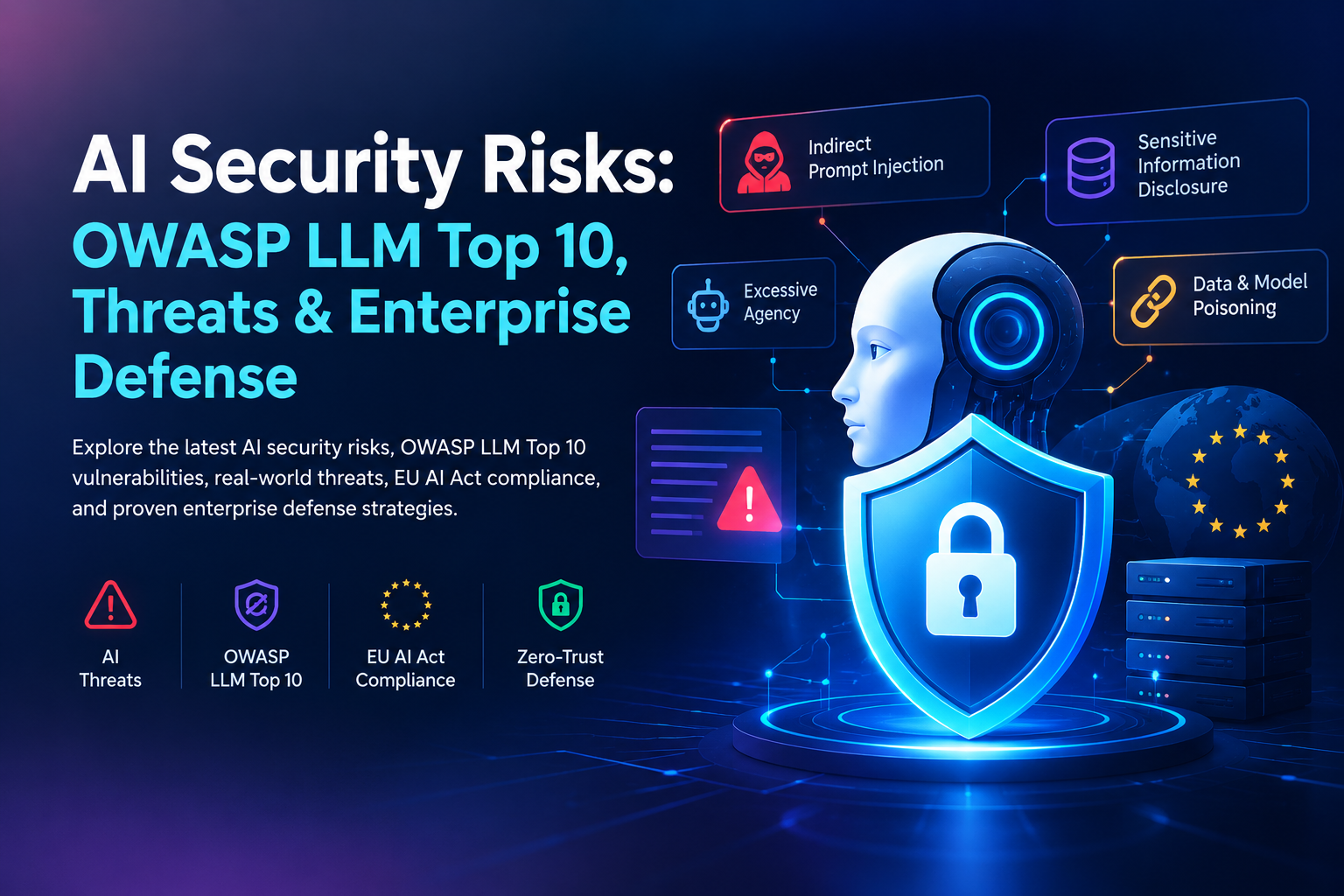
The OWASP Top 10 for LLM Applications and Generative AI tracks the most critical vulnerabilities threatening modern AI infrastructure:
                     ┌────────────────────────────────────────┐
                     │         Untrusted Input Sources        │
                     │  (Web Scrapes, PDFs, Emails, Databases)│
                     └───────────────────┬────────────────────┘
                                         │
                                         ▼
                     ┌────────────────────────────────────────┐
                     │          LLM Processing Layer          │
                     │   [LLM01: Indirect Prompt Injection]   │
                     │   [LLM05: Data & Model Poisoning]      │
                     └───────────────────┬────────────────────┘
                                         │
                      ┌──────────────────┴──────────────────┐
                      ▼                                     ▼
        ┌───────────────────────────┐         ┌───────────────────────────┐
        │     Downstream Actions    │         │      Data Boundaries      │
        │ [LLM03: Excessive Agency] │         │ [LLM02: Sensitive Info    │
        │ - Unauthorized API Calls  │         │         Disclosure]       │
        │ - Database Write/Deletes  │         │ - PII Exfiltration        │
        └───────────────────────────┘         └───────────────────────────┘
LLM01: Indirect Prompt Injection
Mechanism: Rather than attacking a chatbot through its user interface (direct jailbreaking), malicious instructions are embedded within third-party data sources that the AI ingests—such as emails, PDFs, CRM records, or scraped websites.
Verified Incident: High-severity vulnerabilities like EchoLeak (CVE-2025-32711, CVSS 9.3) proved that an LLM reading an external email could execute cross-boundary data exfiltration without user interaction.
Impact: Uncontrolled execution flow, unauthorized API access, and silent data leakage.
LLM02: Sensitive Information Disclosure
Mechanism: Models memorize proprietary code, API keys, or personally identifiable information (PII) during pre-training, fine-tuning, or within context windows.
Impact: Attackers extract credentials or customer records through crafted inversion prompts or model inference attacks.
LLM03: Excessive Agency & Unbounded Tool Use
Mechanism: Developers provide LLM agents with open-ended API tools, read/write database permissions, or shell execution capabilities without deterministic rate-limiting or human verification.
Impact: A hallucinated response or injected prompt causes the agent to delete records, send unauthorized financial wire transfers, or alter production schemas.
LLM04 & LLM05: Supply Chain & Data Poisoning
Mechanism: Pulling unverified foundation weights, quantized model checkpoints, or LoRA adapters from public hubs (e.g., Hugging Face) exposes deployments to embedded backdoors and malicious serialization payloads.
Impact: Backdoored models behave normally during internal testing but trigger specific behaviors or exfiltrate data when activated by an attacker's target keyword.
2. Regulatory Enforcement Milestones: The EU AI Act
Global AI safety transitioned from theoretical ethics to legal compliance with the phased rollout of the European Union Artificial Intelligence Act (EU AI Act):
Milestone Date | Enforced Provision | Affected Entities | Operational Impact |
February 2, 2025 | Prohibited AI Practices & AI Literacy | All deployers and developers | Ban on social scoring, cognitive behavioral manipulation, and untargeted facial scraping; mandatory staff training. |
August 2, 2025 | General-Purpose AI (GPAI) Governance | Foundation model providers (LLM creators) | Model documentation, copyright transparency summaries, and systemic risk evaluations. |
August 2, 2026 | High-Risk AI Systems & Financial Penalties | Annex III high-risk deployers (Fintech, HR, Critical Infra) | Mandatory conformity assessments, continuous risk management, CE marking, and fines up to €35M or 7% of global turnover. |
August 2, 2027 | Embedded High-Risk Products | Annex I hardware/software manufacturers (Medical Devices, Industrial Machinery) | Integration of AI Act standards with existing EU product safety certifications. |
3. High-Risk Vulnerabilities: Attack vs. Defense Matrix
Vulnerability Type | Threat Surface | Primary Exploitation Method | Hardened Defense Standard |
Prompt Injection | Context window, RAG retrievals | Polyglot attacks, Markdown image injection, hidden tags | Strict system/user token tagging, dual-model input classification, egress firewall |
Excessive Agency | Function calling, API webhooks | Manipulated parameters, unintended tool chains | Least-privilege API scopes, read-only defaults, human-in-the-loop approvals |
Supply Chain Poisoning | Model weights, PyPi/npm dependencies | Compromised checkpoints ( | Model Software Bill of Materials (SBOM), cryptographic signature checks |
Synthetic Deepfakes | Identity verification, executive comms | Sub-second voice cloning, dynamic face swapping | Multi-factor cryptographic challenges, C2PA digital watermarking |
4. Engineering Blueprints: Building a Zero-Trust AI Architecture
Treating model inputs and model outputs as unauthenticated, untrusted data streams is the core rule of AI systems engineering:
1. Architectural Privilege Sandboxing
Never grant an LLM direct read/write credentials to operational databases. Implement an intermediary microservice acting as a gatekeeper:
The LLM drafts an intent payload (e.g.,
UpdateInvoiceStatus(id=42, status="Paid")).The broker validates schema parameters, checks role-based access control (RBAC), and checks user session state before execution.
Destructive actions (
DELETE,DROP,TRANSFER) require two-factor human authentication.
2. Guardrail Orchestration Layers
Place a secondary, lightweight classifier (such as Llama Guard or NeMo Guardrails) in front of the main reasoning agent to:
Strip hidden delimiter characters and known injection patterns before LLM consumption.
Redact PII (Social Security numbers, credit cards, credentials) from model outputs before sending responses to users or logging tools.
3. Isolated Context Boundaries for RAG
When building Retrieval-Augmented Generation workflows:
Do not merge unauthenticated web scrapes directly with system instructions.
Enforce tenant-level metadata filtering in vector databases to ensure tenants cannot retrieve embeddings belonging to another customer.
Frequently Asked Questions (FAQ)
What is the difference between direct and indirect prompt injection?
Direct prompt injection (jailbreaking) occurs when a user directly commands an AI to ignore its safety constraints via the input prompt. Indirect prompt injection occurs when the AI processes third-party data (a webpage, email, or PDF) containing hidden adversarial commands that override the agent's baseline instructions without user intent.
How does the EU AI Act regulate generative AI models?
The EU AI Act classifies General-Purpose AI (GPAI) under a two-tiered system. All GPAI model providers must document training data sources, adhere to copyright rules, and release technical summaries. Models posing systemic risks must conduct adversarial red-teaming, track incident reports, and implement energy-efficient training protocols.
Why is excessive agency considered a top AI security risk?
Excessive agency occurs when an AI agent has broader privileges or more autonomy than its assigned task requires. If the agent is compromised by prompt injection or suffers a severe hallucination, it can autonomously alter critical files, execute unauthorized financial transactions, or trigger breaking infrastructure changes.


Comments & Discussion
Leave a Comment
Share your questions, ideas, or architectural feedback. Your comment will appear immediately.
No comments yet
Be the first to share your thoughts or start a discussion on this topic.